BUDGET: Between 1 crore INR and 4.99 crore INR (More than USD135,000 but less than USD540,000)
Project Overview
The Shaheed Veer Narayan Singh Museum in Raipur, Chhattisgarh, is a fifteen-gallery walkthrough that maps the little-documented history and living culture of India’s tribal heartland. Its curators spent years researching and building physical dioramas and layered sets, life-size mannequins, sculpted 3D scenes and dramatic lighting. Nolabel Immersive was invited to overlay an immersive layer, so that static tableaux became living, responsive stories.
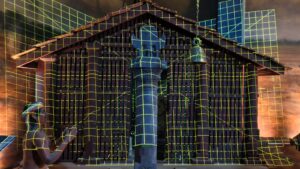
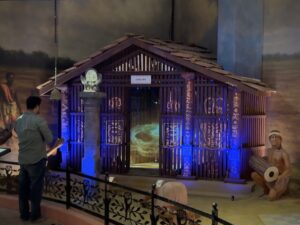
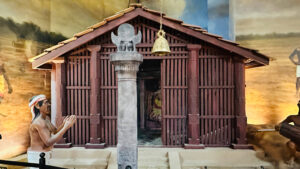
We designed and integrated audiovisual experiences across various galleries. Our flagship is the Danteshwari Temple exhibit, a scaled replica of one of Chhattisgarh’s most revered pilgrimage shrines. Our brief was to let visitors feel the temple without travelling to it: its ambience, its acoustics, its sanctity.
We wrapped the shrine in a low-frequency spatial soundscape and for the first time in our practice embedded an intelligent, on-site audio model at the exhibit edge. A real brass temple bell hangs at the entrance. When a visitor rings it, the edge model recognises that specific bell’s acoustic signature and “awakens” the temple: projection-mapped tribal motifs bloom on its surfaces while inside the shrine comes alive recreating the Hindu ritual where the bell cleanses the space before prayer.
What did the client want to achieve?
The curatorial team had invested years of research into telling Chhattisgarh’s tribal story through richly built physical sets. Their concern was that, however beautiful, static dioramas risk being looked at rather than experienced. They wanted a layer of technology that would deepen engagement without overpowering the craftsmanship already in place, technology that felt invisible and native to each scene, not “screens bolted on.”
For the Danteshwari installation specifically, they wanted visitors to encounter a living temple: to stand before the replica and receive the full sensory reality of the real pilgrimage site, its enveloping sound, its atmosphere, its devotional charge, without ever leaving the museum. Crucially, the experience had to be participatory and rooted in authentic ritual, so that a visitor became a devotee for a moment rather than a spectator. The measure of success was emotional: visitors should feel awe and reverence, and the digital intervention should honour, never trivialise, a site of deep faith.
Scope of work your company was involved in
Nolabel Immersive was engaged as the digital-experience and AV integration partner, working over the curators’ completed physical sets. Our scope covered concept design, content creation, audio design, hardware specification, systems integration, on-site installation, calibration and commissioning and fully automated operations and maintenance of various galleries designed to run unattended in a public museum environment.
For the Danteshwari Temple exhibit this included:
- Experience design: choreographing the “dormant – awakened” temple sequence triggered by the visitor ringing the bell.
- Spatial audio: Low-frequency ambient soundscape that fills the shrine with the resonance of a live temple.
- Edge AI: Training and deploying a compact, on-site audio-recognition model using high fidelity microphones connected through a PC that listens for the signature of the physical brass bell and fires the awakening sequence, running entirely offline within the exhibits.
- Projection and visual mapping: mapping animated tribal motifs onto the temple replica and inside it so its environment bloom.
- Show control & integration: synchronising audio, visuals and the bell trigger into a single reliable, self-contained show that resets for every visitor.
What key challenges were faced?
Detecting the bell reliably was the central challenge. In a busy public gallery filled with chatter, footfall and audio bleeding from neighbouring exhibits, the system had to recognise one specific brass bell and ignore everything else, instantly, every time or the magic would break.
It also had to work entirely offline. As remote museum installation there was no dependable cloud connectivity, so any intelligence had to live on-site, on the exhibit itself.
There was a cultural challenge too. Danteshwari is a site of profound faith. Any misstep, a gimmicky effect, a mistimed trigger, risked trivialising something sacred. The intervention had to feel reverent and authentic, not like a technology demo.
Physically, we were adding a digital layer onto sets that were already fully fabricated. We could not move walls or re-sculpt the shrine; our audio, projection and sensing had to conform to existing geometry, sightlines and lighting.
Finally, spatial audio in an open-plan gallery threatened to bleed into adjacent exhibits, and the whole show had to run unattended in continuous public use, surviving constant, sometimes rough, repeated bell-ringing and resetting cleanly for the next visitor.
How were those challenges resolved?
To solve reliable detection we trained a compact audio-recognition model exclusively on the acoustic signature of the specific brass bell we procured, its fundamental tone, bass and decay. The model learned that bell, firing accurately even against gallery noise. It ran on a small on-site edge device inside the exhibit, so the experience worked fully offline with no cloud dependency and near-zero latency between the ring and the temple’s response.
We honoured the site’s sanctity by anchoring the experience in authentic ritual: the bell is the real devotional act that, in Hindu practice, cleanses a space before prayer so the technology simply rewarded a genuine gesture rather than inventing a gimmick.
Working over finished sets, we specified and mapped every element to the existing geometry, calibrating projection and audio on site within the built shrine. Directional spatial-audio placement and careful level tuning contained the soundscape to the exhibit and minimised bleed. And we engineered the show as a robust, self-resetting loop that runs unattended, tolerating repeated public interaction and returning cleanly to its dormant state for the next visitor.
How has your work helped the client?
The digital layer transformed the museum from something visitors observe into something they participate in. The Danteshwari exhibit became a signature, talked-about moment of the visit the point where a static replica becomes a living temple in response to the visitor’s own action.
For the client, a government cultural institution whose mandate is to preserve and popularise Chhattisgarh’s tribal and devotional heritage, this delivered the core goal: deeper, more emotional engagement that makes the underlying research memorable. Visitors don’t just read about the Danteshwari shrine; they perform its ritual and feel its atmosphere, carrying that experience away with them. This raises the exhibit’s dwell time and shareability and strengthens the museum’s positioning as a modern, world-class cultural destination.
Because the installation is fully self-contained, offline and self-resetting, it also gave the client a low-maintenance asset that runs reliably in daily public operation without technical staff on hand. The result is an experience that honours a sacred site, amplifies the curators’ original storytelling, and gives the institution a distinctive, high-impact centrepiece.
What are you most proud of about the project?
This was the first time we embedded genuine on-site intelligence into a physical installation and we’re proudest that we did it in service of emotion, not spectacle. A visitor performs the oldest, simplest devotional act, ringing a temple bell, and an edge-AI model listening only for that bell brings a sacred space to life. The technology disappears; only the wonder remains.
We’re proud that machine learning was used here to deepen faith and reverence rather than to show off, that we married a first-of-its-kind acoustic trigger with authentic ritual so respectfully that visitors experience it as magic, not as tech. Turning a static replica of one of Chhattisgarh’s holiest shrines into a living, breathing temple that awakens at a devotee’s touch, reliably, offline, in a public government museum, is the kind of invisible, meaningful engineering we set out to make. It set a new benchmark for our own practice, and for what interactive heritage exhibits in India can be.
VIDEO link of the project space: