BUDGET: Between 5 crore INR and 9.99 crore INR (More than USD672,000 but less than USD1.35 million)
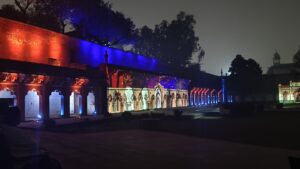
Project Overview
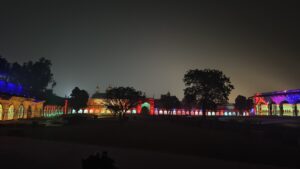
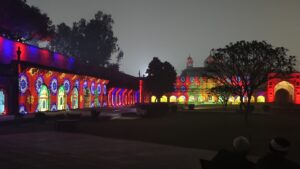
The project involved the complete technological upgradation of the iconic Sound & Light Show at Agra Fort, a UNESCO World Heritage Site, under the Uttar Pradesh Pro-Poor Tourism Development Project. The objective was to transform the legacy Son et Lumière experience into a contemporary multimedia spectacle using large-format projection mapping, immersive audio, synchronized lighting, and advanced show control systems.
The project encompassed engineering, procurement, installation, content creation, programming, commissioning, and five years of operation and maintenance. New high-resolution projection mapping content, original animations, immersive sound design, and multilingual voiceovers were developed while preserving the historical narrative and cultural significance of Agra Fort.
What did the client want to achieve?
The Department of Tourism sought to reimagine the existing Sound & Light Show into a technologically advanced Son et Lumière experience capable of enhancing Agra’s night-time tourism while preserving the historical significance of Agra Fort.
The vision was to replace aging systems with a modern projection mapping solution that could create immersive storytelling across the monument’s architectural façade. Alongside the technology upgrade, the client wanted fresh visual content, high-quality animations, enhanced sound design, and professional voiceovers that retained the essence of the original script while presenting it in a more engaging and emotionally impactful manner.
Equally important was the requirement to execute the project without compromising the heritage character of the UNESCO World Heritage Site. The solution needed to be reliable, easy to operate, and sustainable for long-term use through a comprehensive five-year operation and maintenance programme. The upgraded show was envisioned as a flagship tourism attraction that would increase visitor engagement and strengthen Agra’s position as one of India’s premier cultural destinations.
Scope of work your company was involved in
We delivered the project on a turnkey EPC basis, covering engineering, procurement, system integration, installation, programming, commissioning, and long-term operational support.
The scope included designing and deploying a state-of-the-art projection mapping solution, professional audio systems, lighting systems, show control infrastructure, networking, and associated AV hardware required to modernize the existing Sound & Light Show.
A major component of the project involved complete content redevelopment, including historical research support, storyboard development, high-resolution graphics, 2D and 3D animations, projection mapping content, immersive audio design, multilingual voiceovers and show sequencing to create a compelling visitor experience.
Special emphasis was placed on integrating all AV systems into a unified automated show-control environment capable of delivering precise synchronization between projection, audio, lighting, and playback systems.
In addition to project execution, Tricolor India Schauspiel was entrusted with comprehensive management, operation, preventive maintenance, and technical support for a period of five years, ensuring long-term sustainability of the attraction.
What key challenges were faced?
Executing a large-scale multimedia installation within Agra Fort presented significant engineering and conservation challenges. As a UNESCO World Heritage Site, all installation activities had to comply with stringent heritage conservation guidelines, severely limiting structural intervention or permanent modifications.
The primary performance area offers an approximately 270-degree viewing environment with expansive landscaped zones, varying projection distances, and relatively low-height architectural façades. Achieving uniform image geometry, brightness, alignment and visual continuity across these surfaces required extensive projection studies, precision engineering, and careful equipment placement.
Equipment locations also had to be selected without obstructing visitor circulation or impacting the monument’s aesthetics. Environmental conditions including dust, extreme temperatures, humidity, and seasonal weather variations demanded robust system protection and reliable infrastructure.
The integration of modern projection mapping, synchronized audio, lighting, networking, and automated show control into an existing heritage environment required meticulous planning to ensure seamless operation while maintaining the authenticity and integrity of the historic site.
How were those challenges resolved?
Every stage of the project was planned around the principle of minimum intervention and maximum preservation. Detailed site surveys, projection simulations, and engineering insights were undertaken to identify optimal equipment locations without affecting the monument’s architectural fabric.
Custom mounting solutions and carefully engineered installation methodologies were adopted to comply with heritage conservation requirements while maintaining precise projection geometry and long-term system stability. Projection mapping was extensively calibrated to compensate for irregular architectural surfaces and varying projection distances, ensuring seamless image alignment across the façade.
All AV subsystems—including projection, audio, lighting, playback, networking, and show control—were integrated into a centralized automated control architecture, enabling accurate synchronization and reliable day-to-day operation.
The result was a technically sophisticated yet operationally simple system capable of delivering a consistent visitor experience while respecting the historical and architectural significance of Agra Fort.
How has your work helped the client?
The upgraded Sound & Light Show has transformed Agra Fort into a compelling evening tourism destination by combining heritage storytelling with contemporary multimedia technology. The modern projection mapping experience provides visitors with a significantly more immersive and engaging presentation, enhancing their understanding of the fort’s rich history while extending the overall visitor experience beyond daytime hours.
The integrated AV infrastructure offers improved operational reliability, simplified show management, and a future-ready platform capable of supporting long-term operation through the five-year maintenance programme.
By introducing world-class projection mapping, synchronized audio, and advanced show control technologies, the project has strengthened the Department of Tourism’s objective of promoting cultural tourism, increasing visitor engagement, and enhancing the overall appeal of Agra as an international heritage destination.
The project also establishes a benchmark for deploying advanced systems integration within protected heritage environments without compromising conservation principles.
What are you most proud of about the project?
We are most proud of successfully integrating cutting-edge multimedia technology within one of India’s most significant UNESCO World Heritage Sites while preserving its architectural and historical integrity.
The project demonstrates how advanced systems integration can coexist with heritage conservation through thoughtful engineering, precise execution, and close coordination with multiple stakeholders. Beyond installing technology, we created an immersive storytelling experience that brings centuries of history to life through synchronized projection mapping, audio, lighting, animation, and show control.
Equally significant is the installation’s long-term sustainability through a comprehensive five-year operation and maintenance programme, ensuring consistent performance for thousands of visitors.
The project reflects our capability to deliver technically complex, culturally sensitive, and operationally reliable experiences that elevate heritage tourism through innovation.
VIDEO link of the project space: