BUDGET: 10 crore INR and above (USD1.48 million and above)
Project Overview
South Goa doesn’t have a tradition of hosting national conventions — it has resorts, beaches, and construction sites. On one of those sites, over thirteen months, ONGC built itself out of that gap: three buildings, rising together, meant to open on the same date whether or not the paint was dry.
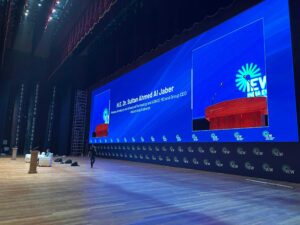
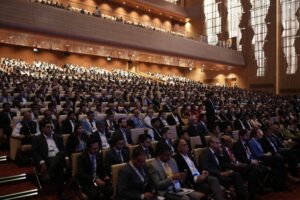
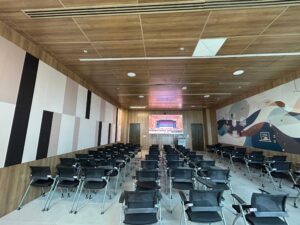
By late December 2025, it very nearly wasn’t ready. A 5,000-seat auditorium, tall enough to swallow a football pitch’s worth of trussing, still had bare walls a month before India Energy Week 2026 was due to open. Then, in eight days flat, a 30 x 8.6-metre Christie LED wall went from crate to commissioned. A CEO Conference Room built for ministers found its custom table with four days to spare. A Management Development Facility — classrooms, syndicate rooms, a training auditorium of its own — came alive on the far end of the same campus, engineered so ONGC’s own trainers could run it without a technician in sight.
SI carried the whole of it: design, supply, installation, integration and commissioning across the ₹50.11 crore scope, on a tender awarded by the PMC Engineers India Limited on behalf of ONGC in March 2025. What stood on that site by January 2026 wasn’t a stage set built for one event and struck afterward — it was a campus ONGC will use for every one that follows.
What did the client want to achieve?
ONGC wanted a facility Goa could keep. India Energy Week 2024 had proven the state could host a national event; it hadn’t proven ONGC could stop renting one back every time it needed to — screens, speakers and staging had arrived and left with the delegates each time. The Convention Centre had to end that dependency on its own: flexible enough to run as one large event or absorb two at once, and secure enough that ministers and foreign delegations could meet there without a rented solution sitting in the room.
Alongside it, ONGC wanted something it had never owned outright — a place to train its own people. The brief for the Management Development Facility came down to one line: if a lecturer walks in, the room should already know what to do. No technician on standby, no dependence on whoever built the system, just competence in the room deciding how the session goes.
Both ambitions were tied to the same fixed point on the calendar — India Energy Week 2026 — with no room to slip either one.
Scope of work your company was involved in
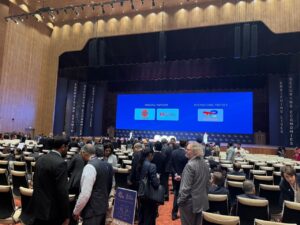
The Convention Centre carries the 30 x 8.64m Christie 4mm LED wall with a TvOne Processor , 8 TW Audio line arrays, 8 30x PTZ cameras and a 750-delegate Televic interpretation network with 8 interpreter desks — routed through Q-SYS Core X10 and Q-SYS encoders/decoders. The same backbone drives 450-plus QSC ceiling speakers for BGM, PA and fire evacuation across the auditorium and every corridor & green room, plus 53 surface-mount speakers covering the Exhibition Hall.
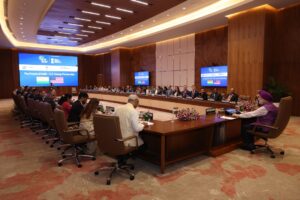
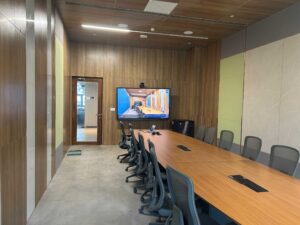
The CEO Conference Room has 53 retractable Televic mics on Arthur Holm lifts with 53 nameplates, a 5-desk, 50-device interpretation system, a 6 x 3.3m 1.5mm Samsung COB LED wall, 6 QSC PTZ cameras, a Poly G62 VC codec, and a 17″ retractable chairman monitor. The Bilateral Room runs a 3 x 1.5m 1.5mm Samsung LED wall with Sennheiser mics and a 25-delegate Televic interpretation system.
Across the MDF: 8 classrooms on 135-inch COB LED walls with dual PTZ cameras apiece, a Conference Room on its own 3 x 1.5m 1.5mm LED wall, 8 syndicate rooms with interactive displays and cameras, a Meeting Room, and a 120-seat auditorium on twin 146-inch COB LED walls with Sennheiser voice-lift mics — all on Q-SYS, with 200-plus ceiling speakers carrying BGM, paging and fire into classrooms, VIP lounges, dining hall and cafeteria.
What key challenges were faced?
The project had thirteen months from civil foundation to handover, with a fixed, immovable date: India Energy Week 2026. AV cannot go into a room until the room is finished, and across all three buildings, that access only came in the last week of December 2025 — while painting and interior work were still running around the crews.
The two rooms carrying the most weight were also the last ready. The CEO Conference Room and Bilateral Talks Room had their interiors handed over on 10 January 2026, and the custom fifty-three-seat table — built to hide its own microphones — arrived on 20 January. That left seven days before ministers would be sitting at it.
The site worked against the equipment as much as the calendar. South Goa has little AV supply infrastructure nearby, and the campus stayed an active construction zone for most of the build — dust and humidity, neither one forgiving toward a 30-metre LED wall or a line array waiting to go up.
And once the rooms were finally ready, the people running India Energy Week weren’t ready for them: an event operations team used to its own touring gear, handed a permanently integrated AV over IP network it had never operated before.
How were those challenges resolved?
Every day the site withheld was a day we had to win back before work even began, so as much of the project as possible moved offsite. Long-lead equipment — the Christie wall, the TW Audio arrays — was bought early against approved BOQs and held in a dedicated, climate-controlled warehouse in Goa, away from the construction dust, until each building was ready to receive it.
The Q-SYS environment for every room, including the CEO Conference Room and Bilateral Talks Room, was designed and programmed offsite against finalised signal-flow diagrams before a single rack went in. That’s what made four days enough: when the executive table arrived on 20 January, what remained was deployment and testing, not development from scratch. Parallel teams worked all three buildings at once; the Christie wall itself went from crate to fully commissioned in eight days.
For the operations gap, we ran handover and familiarisation sessions with the event team before India Energy Week began, then split responsibility during the event — the auditorium run jointly with them, while our own engineers personally operated the CEO Conference Room and Bilateral Talks Room through the ministerial sessions, since there was no time to train anyone else on systems commissioned days earlier.
How has your work helped the client?
ONGC now owns a venue instead of borrowing one. Where the 2024 edition of India Energy Week depended on tents, rented LED and a teardown crew at the end, the 2026 edition ran out of a building ONGC will still be using long after the last delegate flies home — a permanent home for the country’s biggest energy conversations, not a stage rebuilt from zero every time.
That permanence buys operational independence. ONGC can now host a single 5,000-person event or split the auditorium for two running in parallel, seat a minister at a table that hides its own microphones, and interpret across languages for hundreds of delegates without hiring in a rental fleet each time. None of it depends on SI being on site once the ribbon is cut — the systems were built to run on their own.
The bigger shift is in the Management Development Facility. ONGC had never had a dedicated campus for its own executive training before; now it does, built to the client’s own standard — a lecturer walks in, the room already knows what to do. Training that used to mean booking a hotel now happens on ONGC’s own ground, on ONGC’s own schedule.
The next national event Goa hosts doesn’t need a new tender. It needs a booking.
What are you most proud of about the project?
What we’re proudest of is harder to point at than a pixel count or a seat number. It’s standing at the back of a room while a minister spoke into a microphone that had been sitting in a warehouse three weeks earlier, and watching it disappear into the moment the way it was built to — nobody in that room thinking about the AV, because there was nothing left to think about.
This wasn’t a boardroom for a bank or a ballroom for a wedding. It was built for India’s energy conversations with the world, on Indian ground, running on systems Indian engineers commissioned days before the country was watching. There’s a particular kind of pride in that — not in the wattage or the pixel pitch, but in knowing a small piece of how India presents itself to the world passed through our hands, and held.
We won’t be in the 5,000 seater auditorium or the CEO Conference Room the next time a minister addresses the gathering. The system will be — quietly doing its job, the way it did the first time, long after anyone remembers who built it. That’s the part we carry with us, and we’d do it all again.
VIDEO link of the project space: