BUDGET: Between 5 crore INR and 9.99 crore INR (More than USD672,000 but less than USD1.35 million)
Project Overview
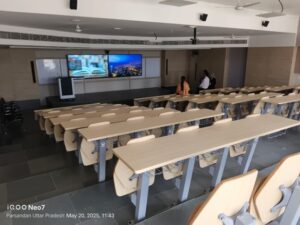
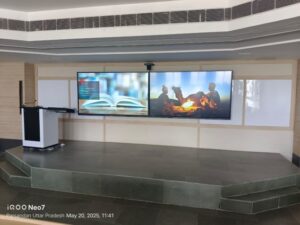
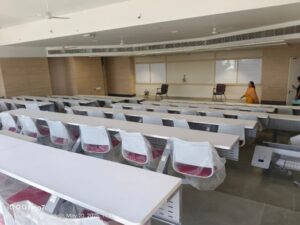
● Delivered a standardised, camera-ready smart-classroom AV solution across 83 classrooms at Chandigarh University’s Lucknow campus.
● Covered four distinct room types: 7 camera-enabled 72-seat rooms, 37 72-seat rooms without cameras, 18 40-seat classrooms, and 21 80-seat lab rooms.
● Equipped 72-seat rooms with interactive displays, and 40-seat/lab rooms with projector-and-screen setups.
● Installed AI-tracking 4K PTZ cameras for teacher framing in the 7 camera-enabled rooms.
● Standardised HDMI/USB-C interfacing at every lectern for unified connectivity.
● Delivered campus-wide ceiling and surface speaker coverage driven by DSP-based audio processing, with wireless microphones for instructors.
● Centralised AV control and switching across all rooms.
● Engineered every room for reliability, ease of use for non-technical faculty, and quick turn-on.
● Enabled lecture capture, remote participation, and clear speech reinforcement throughout.
● Designed and commissioned within the university’s academic calendar window (19 March 2025 to 13 October 2025), minimising disruption while establishing a single, repeatable classroom standard across the estate.
What did the client want to achieve?
● Wanted all 83 classrooms across four different room sizes and formats to deliver the same reliable hybrid-teaching experience.
● Sought a common AV and control workflow so faculty could walk into any room and start a lecture, capture, or remote session without retraining.
● Wanted all 83 classrooms across four different room sizes and formats to deliver the same reliable hybrid-teaching experience.
● Sought a common AV and control workflow so faculty could walk into any room and start a lecture, capture, or remote session without retraining.
Scope of work your company was involved in
● Covered end-to-end supply, installation, testing, and commissioning of classroom AV systems across all 83 University rooms.
● Installed interactive displays in the 72-seat rooms and laser projector/screen combinations in the 40-seat and 80-seat lab rooms.
● Deployed AI-tracking 4K PTZ cameras for instructor framing in the 7 camera-enabled rooms.
● Implemented HDMI/USB-C wall-plate interfacing with active optical cabling for long, high-bandwidth runs.
● Built a DSP-based audio chain feeding ceiling and surface loudspeakers through dedicated amplification.
● Provided wireless headworn and gooseneck microphones for instructors.
● Established a centralised HDMI/USB switching and control layer over a PoE network for remote management.
● Conducted room-by-room acoustic tuning across all four room types.
● Standardised the user interface across all room formats.
● Delivered commissioning support to bring the full 83-room portfolio online within the academic calendar.
What key challenges were faced?
● Faced signal-degradation risk from long cable runs between wall plates, switching, and displays in larger rooms and multi-floor buildings, replicated across 83 rooms.
● Encountered acoustic variability, as rooms differed in size, shape, and finish across four distinct formats (40 to 80 seats), meaning a single fixed audio tuning could not deliver even speech coverage.
● Needed to maintain one standardised user experience despite only 7 of the 83 rooms carrying teacher-tracking cameras.
● Required the interface and workflow to feel identical to faculty across both camera and non-camera rooms.
● Operated under a firm academic-calendar deadline that demanded many rooms be commissioned in parallel.
How were those challenges resolved?
● Addressed signal integrity over distance using active optical HDMI/USB cabling with disciplined cable management and routing standards, applied consistently across all 83 rooms.
● Resolved acoustic variability with DSP-based presets and room-type tuning, calibrated per room category rather than a single generic setting.
● Kept speech coverage even regardless of room size through this room-specific calibration.
● Standardised a common HDMI/USB-C interfacing and control workflow across camera-enabled and non-camera rooms alike.
● Delivered an identical on-screen experience to faculty across all four room types, cutting training and helpdesk load.
● Commissioned rooms in phases against the academic calendar, replicating the standardised design quickly once validated in the first rooms.
How has your work helped the client?
● Simplified day-to-day teaching by turning hybrid sessions into a routine, one-touch experience across all 83 rooms rather than a special setup.
● Delivered consistent speech clarity to faculty in every room.
● Reduced technical friction at the start of class through the common HDMI/USB workflow.
● Enabled the university’s IT team to support the whole estate with a single playbook instead of room-by-room troubleshooting.
● Kept delivery on schedule against a fixed academic-calendar deadline.
● Reinforced confidence in the platform through responsive support since handover.
● Positioned the university to extend the same standard to future buildings.
What are you most proud of about the project?
● Achieved genuine standardisation at real campus scale, delivering one repeatable smart-classroom design across 83 rooms spanning four different sizes and formats.
● Commissioned all 83 rooms inside one academic calendar window without disrupting teaching.
● Delivered a classroom experience that feels identical to faculty everywhere on campus.
● Backed the deployment with consistent speech clarity and dependable hybrid-session performance from day one.
● Achieved strong, immediate adoption from teaching staff.
VIDEO link of the project space: Not available