BUDGET: Between 5 crore INR and 9.99 crore INR (More than USD672,000 but less than USD1.35 million)
Project Overview
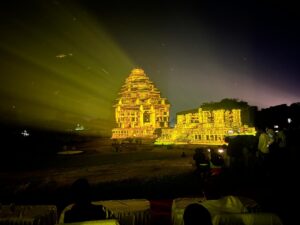
The Konark Light and Sound Show renewed an ageing installation while protecting this UNESCO World Heritage precinct, under ASI protocols.
Earlier, audiences sat in the temple’s core garden, with conspicuous projector masts lining the pathway and a visible control room.
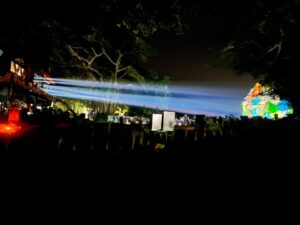
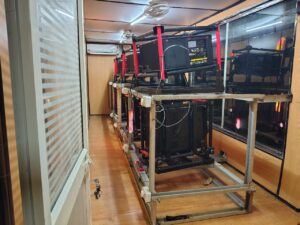
Seating moved to an elevated, non-intrusive zone, containing audio within the audience area to safeguard the monument while delivering 5.1 surround. Eight 30,000 lumen, three chip DLP laser projectors were consolidated within an integrated, camouflaged, double storied facility outside the archaeological zone.
Relocation created an exceptional optical challenge. Content authored for the old PoV, projector positions, lenses, throws and blends had to fit an entirely new configuration. Through simulation and pixel-level correction, each frame was translated into the new optical geometry. Perspective correction, warping, edge blending and colour calibration preserved the composition while resolving eight outputs into one seamless canvas. To our knowledge, this feat has no precedent in a comparable heritage projection upgrade.
Climate control protects systems from salt, humidity, monsoon rain and wildlife. The technology remains almost invisible by day… yet brings Konark magnificently alive after sunset.
What did the client want to achieve?
The client sought to transform an ageing installation into a contemporary, reliable and immersive visitor experience while preserving the sanctity of an ASI-protected UNESCO World Heritage Site.
A key objective was to remove intrusive projector masts and visible control infrastructure. With the audience relocated to an elevated viewing area, the system had to provide unobstructed views of the Sun Temple and mandapam while remaining virtually invisible by day.
The established content was to be retained, but presented with improved brightness, resolution, colour fidelity, geometric accuracy and audiovisual impact. The client also required intelligible, immersive audio across Konark’s windswept outdoor environment.
Above all, the installation had to balance technological advancement with heritage sensitivity. It needed to withstand salt-laden air, humidity, monsoon rain, heat, lightning and wildlife while remaining safe, maintainable and dependable for long-term operation.
Scope of work your company was involved in
We were the turnkey integrator for redesign, supply, installation, programming, calibration, testing and commissioning of the projection, media control and outdoor audio systems.
The scope began with site surveys, legacy system evaluation and simulation of revised viewing geometry. Axis engineered projector positions, throw distances, lens selection, optical alignment, signal routing, power and environmental protection.
Eight 30,000 ISO lumen, three chip DLP laser projectors were integrated with a server grade media platform supporting synchronised playback and 4K output per channel. Existing content was remapped through perspective correction, warping, edge blending, colour calibration and luminance balancing across the Sun Temple and the Mandapam.
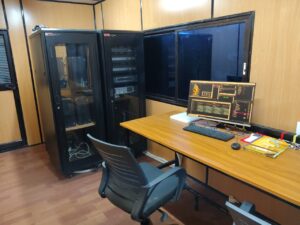
We created a camouflaged, double storeyed facility with the control room below and projector array above, incorporating climate control, insulation and moisture protection. Fibre distribution, networking, show control, UPS, cabling, surge protection, earthing and lightning protection were integrated.
We also engineered and aligned the multichannel audio system. Final responsibilities covered audiovisual synchronisation, optimisation, documentation, operator support and comprehensive maintenance.
What key challenges were faced?
Integrating technology at an ASI-protected UNESCO World Heritage Site allowed no drilling, anchoring or attachment to the monument. Every element had to be sensitively integrated within the protected archaeological zone, remaining structurally independent, non-invasive and visually recessive within the landscape.
Relocating the audience and eight projectors created an optical challenge without known precedent in a comparable heritage upgrade. Content authored for one PoV, projector positions, lenses, throws and overlaps had to be translated pixel by pixel into an entirely different configuration. Optical offsets, incidence angles, parallax, pixel density and every blend zone changed, while the temple and mandapam remained fixed. Perspective had to survive without keystone distortion, pixel elongation, brightness loss or visible blends.
Coastal salt, humidity, heat, monsoon rain, condensation and wildlife threatened equipment and signals.
Installation continued through waterlogging and electrical storms under a compressed schedule. A lightning strike on a nearby tree underlined the danger.
Finally, multichannel audio across a windswept area required control of dispersion, delay, phase and low frequency consistency without intruding upon heritage sightlines.
How were those challenges resolved?
Heritage constraints were resolved through self-supporting audiovisual architecture integrated within the protected zone, with nothing attached to the monument.
Projectors, control and services were consolidated in a camouflaged, double-storeyed facility. The control room occupied the lower level and eight projectors the upper, eliminating intrusive masts.
Simulations recalculated throw ratios, lenses, incidence angles, parallax and overlaps. Content authored for the earlier PoV and optical stack was translated pixel by pixel into the new projector, lens and throw configuration. Perspective correction, warping, masking, edge blending, colour calibration and luminance balancing restored composition while minimising distortion and pixel elongation. To our knowledge, this has no precedent in a comparable heritage upgrade.
A sealed, climate-controlled level managed heat, moisture, salt, condensation and wildlife. Fibre distribution, UPS, earthing, surge suppression and lightning protection strengthened resilience.
Work followed weather windows, with off-site prefabrication reducing site activity. Strategic planting concealed speakers without compromising DSP-calibrated dispersion, delay, phase, intelligibility or 5.1 surround imaging across the windswept area.
How has your work helped the client?
We transformed an ageing, intrusive installation into a contemporary heritage experience that is advanced, dependable and respectful of the Konark Sun Temple.
Relocating the audience provided unobstructed views of the temple and mandapam. Removing pathway projector masts and consolidating infrastructure within a distant, camouflaged facility restored visual integrity. By day, the technology disappears, allowing visitors to encounter the monument without distraction.
The client retained its content while gaining improvements in brightness, resolution, colour fidelity, geometric accuracy and audiovisual impact. Seamless projection across stone surfaces and calibrated multichannel audio create the impression that the monument itself is telling its story.
The climate-controlled installation reduces exposure to salt, moisture, heat, rain and wildlife. Laser projection, fibre distribution, protected power, earthing and lightning protection improve reliability, safety and maintainability. Centralisation simplifies inspection and maintenance.
The client now has a world-class attraction worthy of Konark. Since inauguration, it has engaged thousands of visitors, extended the experience beyond daylight hours and strengthened cultural, educational and tourism value.
What are you most proud of about the project?
What makes us proud is not the power of eight projectors, nor the pixel-by-pixel translation of content from one PoV and optical configuration into another.
It is knowing that, before one of humanity’s greatest monuments, technology had to disappear.
By day, the protected structure remains untouched; Konark stands without projector masts or a control room competing with its silhouette. The engineering remains distant, camouflaged and silent.
Then night falls…
Eight projections converge upon a surface never built to be a screen. Ancient stone, deep relief, broken geometry and the pillared mandapam become one living canvas. Across the windswept landscape, sound seems to emerge from the monument itself.
Konark was always a masterpiece beyond comparison. We sought only to create a system worthy of its magnificence.
Our greatest success is not that people notice our technology…
It is that they forget it, look up at the Sun Temple, and feel that history has awakened.
VIDEO link of the project space: