BUDGET: Between 1 crore INR and 4.99 crore INR (More than USD135,000 but less than USD540,000)
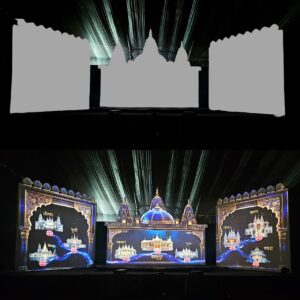
Project Overview
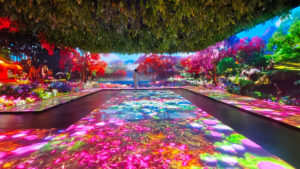
Our project, “Code of Light: A Digital Experience,” is a one-of-a-kind, technology-driven immersive exhibit created for Samiyo-2026, a grand social-religious event organised by the Swaminarayan Kalupur Gaadi to commemorate 200 years of the Shikshapatri. The experience center transformed spiritual storytelling into a large-scale experiential environment. The experience center combined multiple immersive technologies within a single narrative ecosystem to present the life, philosophy, and social contributions of Bhagwan Swaminarayan.
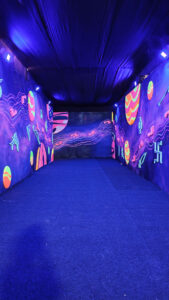
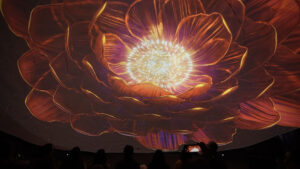
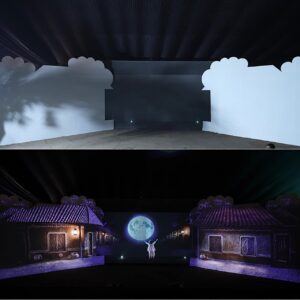
The experience center’s designed narrative unfolded as a connected journey where visitors moved through distinct immersive environments, each designed to communicate a different chapter of the narrative using the most appropriate visualization medium. The installation integrated projection-based experiences, holography, immersive LED environments, a humongous 14-meter dome, augmented reality, synchronized sensory effects, and custom kinetic installations into one cohesive visitor experience.
Code of Light demonstrates how advanced AV engineering, immersive technologies, and centralized systems integration present spiritual content while maintaining synchronized playback, operational stability, and a consistent audience experience.
What did the client want to achieve?
The client sought to create a landmark attraction that would present the teachings of Bhagwan Swaminarayan in a format capable of engaging contemporary audiences while preserving the dignity and authenticity of the spiritual subject.
The experience needed to appeal equally to devotees of different age groups, encouraging longer visitor engagement than traditional exhibitions while remaining emotionally meaningful rather than purely technological.
Operationally, the installation had to support uninterrupted public access throughout the event, manage large visitor throughput efficiently, and function reliably despite extended daily operating hours.
The client also required the solution to become a reference project demonstrating how immersive media could be meaningfully integrated into large religious gatherings without distracting from the spiritual purpose of the centre.
Scope of work your company was involved in
We were responsible for the end-to-end design, engineering, content, integration, and operation of the complete experience. The scope included master planning of the visitor journey, creative direction, scripting, content production, experience design, technical planning, architectural integration, multimedia programming, projection mapping, holographic implementation, immersive LED programming, dome installation and content creation, augmented reality integration, kinetic installation design, audio production, show-control programming, installation supervision, commissioning, operations, and technical management continuously.
The company developed a centralised multimedia ecosystem that synchronised independent display technologies, mechanical systems, audio playback, environmental effects, and interactive experiences into one coordinated operational workflow.
In addition to system integration, we designed audience circulation, optimised batch movement, established operational protocols, and supervised live show operations to ensure reliable performance.
What key challenges were faced?
The project demanded the simultaneous operation of numerous independent experiential systems, each with different playback formats, viewing geometries, brightness characteristics, synchronisation requirements, and operational constraints. Maintaining complete experiential continuity while visitors moved between environments required every transition to appear natural despite significant changes in display technology and physical space.
The integration of dynamic mechanical installations with projected imagery demanded positional accuracy requirements. One of the most unique challenges was the creation of a 14-meter dome, one of the largest dome installations in a religious setting; content calibration and development demanded thorough, spotless precision.
Operational planning presented an equally significant challenge. The installation needed to maintain continuous audience movement without congestion while ensuring every visitor experienced the complete narrative regardless of varying arrival patterns throughout the day.
Extended operating hours increased the importance of system reliability, thermal management, preventative maintenance, acoustic isolation, ambient light control, and rapid technical response to ensure uninterrupted operation.
How were those challenges resolved?
We approached the project as a unified systems integration exercise rather than a collection of independent installations. A centralised show-control architecture synchronised media playback, projection systems, display processors, audio systems, mechanical elements, sensory effects, and timing cues across the complete experience. This ensured that every environment operated as part of a single coordinated production.
Dedicated content pipelines were developed for each visualisation medium, allowing every experience to be optimised for its specific display characteristics while preserving visual continuity across the visitor journey.
Mechanical motion systems underwent repeated calibration and synchronisation with mapped visual content to maintain accurate registration throughout dynamic movement. Audience circulation was modelled in advance to optimise batch sizes, transition intervals, queue management, and overall throughput.
Operational redundancy, continuous monitoring, preventive maintenance schedules, and extensive on-site testing were incorporated into the deployment strategy, enabling the installation to maintain stable performance and synchronised operation.
How has your work helped the client?
The installation established a new benchmark for immersive engagement within a large-scale spiritual exhibit by demonstrating that advanced AV technologies can strengthen, rather than distract from, devotional storytelling. The integrated platform enabled the client to communicate complex philosophical concepts through experiential formats that remained accessible to visitors across generations while preserving cultural authenticity.
From an operational perspective, the project delivered a dependable solution capable of accommodating exceptionally high audience volumes with efficient visitor movement and consistent presentation quality.
The modular systems architecture also provides a foundation for future experiential developments, illustrating how multiple immersive technologies can be successfully deployed within large public gatherings while maintaining reliability, scalability, and operational efficiency.
What are you most proud of about the project?
Knownsense Studios is most proud of successfully engineering one of India’s most comprehensive immersive spiritual experiences through the seamless integration of multiple visualisation, multimedia, and mechanical technologies within a single operational ecosystem.
The project demonstrates that complex AV engineering can remain virtually invisible to audiences when systems integration is executed effectively, allowing technology to serve the narrative rather than dominate it.
Equally significant was the successful delivery of a technically demanding installation capable of sustaining continuous public operation throughout a high-footfall while maintaining synchronisation, stability, and experiential consistency.
Code of Light represents Knownsense Studios’ commitment to combining engineering precision with meaningful storytelling, creating immersive environments that respect cultural heritage while expanding the possibilities of experiential technology.
VIDEO link of the project space: