BUDGET: Between 5 crore INR and 9.99 crore INR (More than USD672,000 but less than USD1.35 million)
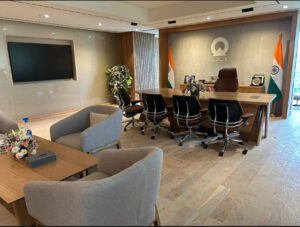
Project Overview
The Quality Council of India (QCI), India’s national body for accreditation and quality promotion, consolidated its multiple offices into a new headquarters at the World Trade Centre, New Delhi, bringing together nearly 2,000 employees across multiple floors in two interconnected towers.
SI was entrusted with delivering a comprehensive end-to-end audiovisual solution for this landmark project. The scope covered more than 30 meeting rooms, Chairman’s cabins, a flagship boardroom for high-level government deliberations, a multipurpose hall integrated with the cafeteria through movable partitions, and a professional broadcast recording studio. One of the project’s key highlights was the Chairman’s broadcast studio, designed for recording podcasts, interviews, leadership addresses, and official communications.
The studio has hosted several distinguished guests, including Shri Piyush Goyal, Hon’ble Union Minister of Commerce & Industry, during the inauguration of the facility, and Jaxay Shah, Chairman of the QCI, for official recordings. The QCI headquarters now stands as one of the flagship projects, demonstrating its expertise in delivering sophisticated audiovisual environments for government institutions and large enterprises.
What did the client want to achieve?
As India’s apex national quality body, QCI required a state-of-the-art audiovisual environment equal to its institutional stature, one that could host ministers, regulators, industry leaders and international delegations with total confidence. The client’s ambition was clear: to modernise its Delhi campus into a fully connected, technology-enabled institution capable of supporting governance at the highest level.
Central to this vision was a boardroom engineered for secure, dependable high-level deliberation, alongside more than thirty meeting rooms and cabins standardised with reliable video-conferencing and display infrastructure. QCI also sought a flexible multipurpose hall and cafeteria capable of functioning independently or as a single unified space, supported by an LED wall, multi-camera coverage and voice-lift amplification for large assemblies.
Perhaps most critically, the client needed a professional recording studio, built swiftly and without compromise, to capture official proceedings involving government dignitaries. Every requirement carried an unspoken mandate: zero tolerance for failure, given the institutional weight of the audiences the systems would serve.
Scope of work your company was involved in
SI was entrusted with the complete design, procurement, installation, integration, testing and commissioning of QCI’s audiovisual ecosystem across two buildings in New Delhi. The scope covered more than thirty meeting rooms and cabins, each equipped with dedicated video-conferencing systems, professional displays and standardised control interfaces to ensure a consistent user experience across the campus.
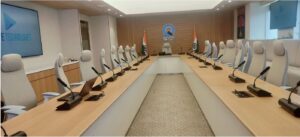
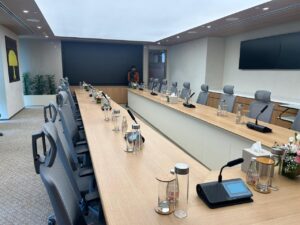
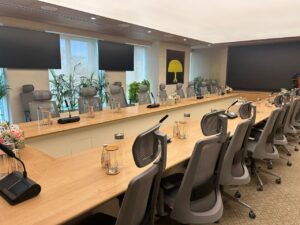
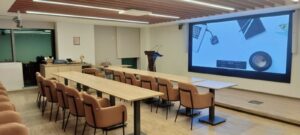
The boardroom was developed as a critical centrepiece, featuring secure conferencing, seamless source switching and dependable AV performance suited to high-level government use. In the multipurpose hall and cafeteria, SI integrated a large-format LED wall, multi-camera switching infrastructure and a voice-lift audio system, enabling the area to operate either as two independent zones or one unified assembly hall through movable partitions.
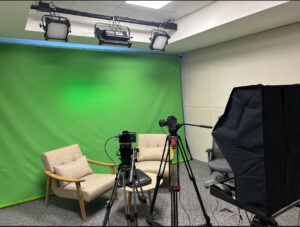
The most demanding deliverable was a fully functional broadcast recording studio, complete with professional recording equipment, cameras, lighting, audio systems and dedicated control infrastructure. It was conceived, built and commissioned within five days to meet a fixed government deadline.
The entire engagement was executed in close coordination with the client and allied agencies, across a live campus.
What key challenges were faced?
The QCI project was one of SI’s most demanding assignments, combining a government installation, an uncompromising deadline and a client brief that evolved almost daily.
The toughest task was delivering a fully operational recording studio in just five days. It required broadcast-grade recording equipment, cameras, lighting, audio systems and a dedicated control room, and had to be camera-ready for government officials on pre-launch day.
The overall scope covered two buildings, more than 30 meeting rooms and cabins, each equipped with video-conferencing systems and displays. The boardroom added further pressure, requiring a secure, dependable AV setup for high-level government deliberations.
The multipurpose hall and cafeteria brought added complexity. Linked by movable partitions, the space had to work seamlessly as one large hall or two separate zones, supported by an LED wall, multi-camera switching and a voice-lift system.
Execution took place inside a live working office, making material movement and installation especially challenging.
Despite the compressed schedule and shifting requirements, the full AV ecosystem was designed, installed, tested and handed over on schedule.
How were those challenges resolved?
Every challenge was addressed through disciplined planning, teamwork and close coordination with the client and allied agencies. Daily reviews helped the team anticipate evolving requirements and absorb changes without affecting the timeline.
From day one, the recording studio was treated as the highest priority. Dedicated crews worked in parallel to make it fully operational ahead of the scheduled government recording session. Across both buildings, multiple teams progressed the meeting rooms, boardroom and multipurpose hall simultaneously.
Nothing was handed over without thorough testing. Every AV system underwent detailed checks across audio, video, lighting, cameras and control interfaces before sign-off, with special attention given to the boardroom and multipurpose hall.
Working within a live office environment created logistical constraints, but the team adjusted material movement and manpower deployment to keep execution on track. Installation followed OEM guidelines and AV industry best practices, ensuring the completed systems met performance and durability standards.
The result was the on-time handover of a complex, multi-building AV ecosystem, delivered without compromising quality and recognised with strong client appreciation.
How has your work helped the client?
SI’s work has fundamentally elevated QCI’s ability to function as a modern, technology-enabled national institution. With reliable AV infrastructure now standardised across more than thirty meeting rooms and cabins, QCI’s teams can convene, collaborate and connect with stakeholders without the friction of inconsistent or unreliable systems.
The boardroom now provides a secure, dependable environment for the organisation’s most sensitive and high-profile deliberations, ensuring that critical government business is never compromised by technology failure. The multipurpose hall and cafeteria, with their combined LED wall, camera switching and voice-lift systems, give QCI the flexibility to host anything from intimate sessions to large-scale assemblies within the same footprint.
Most significantly, the newly commissioned recording studio has given QCI an in-house capability to produce broadcast-quality recordings of government proceedings, a capability the institution did not previously possess. This studio proved its value from day one, hosting the recording of government officials immediately upon completion.
Collectively, these systems have positioned QCI to project the professionalism and authority befitting India’s apex quality body.
What are you most proud of about the project?
What the team is proudest of is completing the recording studio in five days and delivering it, fully functional, on the very day it was needed for the recording of government officials. Watching the studio go live within such a narrow window remains a defining moment for everyone involved.
The boardroom stands out as another high point. The integration brought together a large LED wall, wireless microphones, seamless switching, and auto-source inputs from multiple cable cubbies, alongside the auto-focusing feature that frames the person speaking. The result was an AV experience that felt effortless and thoroughly professional.
Beyond the individual milestones, there is real pride in what the project represented as a whole: a two-building deployment spanning more than 30 meeting rooms, a boardroom, a multipurpose hall, a cafeteria and a broadcast studio, executed against constant change and in a working office without any dip in quality. The client, who is the quality control authority of India, appreciated it at handover; their appreciation was the clearest validation of the effort, and it made every long day on site worthwhile.
VIDEO link of the project space: Not available