BUDGET: Between 1 crore INR and 4.99 crore INR (More than USD135,000 but less than USD540,000)

Project Overview
The Samrat Samprati Museum Koba Tirth, Gandhinagar, Gujarat, is a major Jain heritage and cultural centre spread across two floors along with one multipurpose hall. The museum was inaugurated on 31st March 2026 by the Hon’ble Prime Minister of India, Shri Narendra Modi.
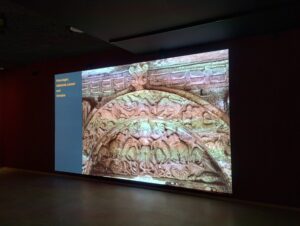
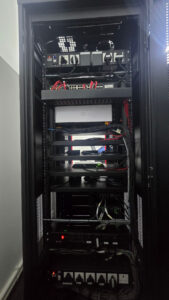
We were engaged as the SI for the complete audiovisual and control infrastructure of the museum, translating each gallery’s storytelling and immersive-experience requirements. The audio design uses a distributed Tannoy satellite speakers, ceiling subwoofers, directional speakers, and full-range LCR/surround loudspeakers, driven by Lab Gruppen amplification and Q-SYS Core110f DSP with Dante audio, enabling precise, zone-controlled,across adjoining open-ceiling galleries without acoustic bleed. Visuals are through Panasonic 4K UHD laser projectors, projected onto Screen Goo-coated surfaces, Show control and playback synchronization are handled by a Dataton Watchout media server and Medialon Showmaster controller, tying every gallery’s audio and video cues into a single, seamless visitor journey. The result is an immersive, technology-led heritage experience befitting a national landmark, designed to engage visitors across 7 distinct galleries while preserving the sanctity and narrative integrity of each space.
What did the client want to achieve?
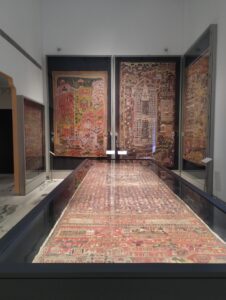
The client wanted to create a museum where the focus remained on the large collection of rare artefacts, with technology used only where it added value to the visitor experience. Since the museum was primarily artefact-led, the audiovisual and interactive interventions were kept selective and carefully planned.
A few dedicated experiential spaces were created for films, animations, projections and multimedia content. These spaces were designed as separate experiences while still connecting with the overall museum journey and supporting the story of each gallery.
The design also addressed the challenge of several exhibits being placed close to one another within open-ceiling galleries. Directional speakers, careful loudspeaker placement and separate audio zones were planned to reduce sound spill and ensure that one exhibit did not disturb the adjoining gallery.
The overall objective was to create a smooth and engaging visitor experience where the artefacts, content and technology worked together as one complete museum environment.
Scope of work your company was involved in
We were involved in the complete systems integration of the project as Systems Integrator; our scope encompassed the design, realisation, supply, installation, testing, and commissioning of the complete audio, video, and control systems across all seven themed galleries, both floors, and the multipurpose hall.
What key challenges were faced?
As the exhibits are located in close vicinity to one another under an open ceiling, confining sound to each individual exhibit without acoustic bleed into adjoining galleries was a significant challenge.
How were those challenges resolved?
Through careful measurement of each space’s requirements and target SPL levels, we controlled sound containment using the audio DSP, along with precise speaker placement and angling, ensuring each gallery’s narrative remained acoustically isolated from its neighbours.
How has your work helped the client?
Our work has helped the client achieve their vision of a museum that not only preserves over 2,000 rare artifacts but presents Jain heritage and culture in a compelling, technology-enabled format worthy of a landmark.
What are you most proud of about the project?
Being entrusted with the audiovisual integration of a national landmark inaugurated by the Hon’ble Prime Minister of India, Shri Narendra Modi, stands out as one of the most defining milestones in our journey. Beyond the scale and prestige of a nationally inaugurated project, what makes this achievement deeply meaningful to us is the subject it serves a museum dedicated to preserving and celebrating Jain heritage, philosophy, and cultural history for generations to come. To have played even a small part in bringing to life a space that promotes such a rich cultural and spiritual legacy is a matter of immense pride for our entire team. It is a reminder that our work goes beyond technology integration it contributes, in its own way, to the preservation and celebration of India’s heritage, and we are grateful and humbled to have been part of this journey.
VIDEO link of the project space: